


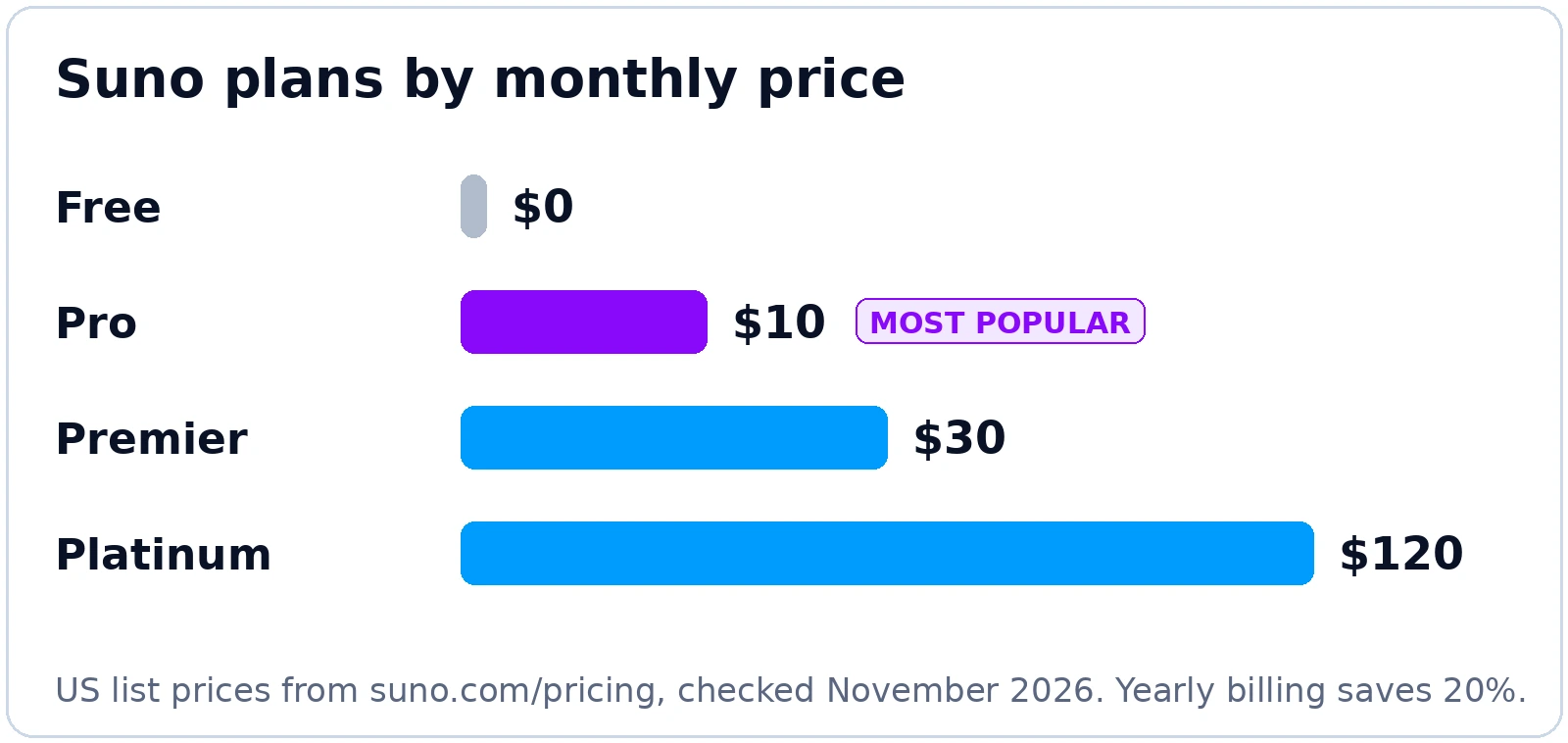
Suno AI pricing looks simple at first glance — four plans, three of them paid — but the number on the pricing page catches people out. Suno opens the page on annual billing, so the first prices you see are $8 and $24 a month. Those are real, but only if you pay for a full year up front. Billed month to month, Pro costs $10, Premier $30 and Platinum $120.
This guide lists every current Suno plan with its monthly and annual price, explains how Suno credits actually work (including the download caps that matter more than credits), and shows you which tier fits how you make music. Comparing AI subscriptions? Our guides to ChatGPT pricing and Claude pricing use the same format.
Suno AI Pricing at a Glance
Here is every Suno plan you can buy today.
| Plan | Price per month | Annual price | What it is |
|---|---|---|---|
| Free (Basic) | $0 | $0 | 50 credits a day (about 10 songs), v6-mini model, personal use only |
| Pro | $10 | $96 | 2,500 credits a month (about 500 songs), 20 downloads a month, commercial rights |
| Premier | $30 | $288 | 10,000 credits a month (about 2,000 songs), 60 downloads a month, Suno Studio |
| Platinum | $120 | $1,152 | 15,000 song credits a month (about 3,000 songs) plus 20,000 visual credits, 120 downloads a month, Suno Studio |
Prices are US list prices before tax — Suno calculates taxes at checkout. Two budgets run side by side on paid plans, and understanding both is the key to Suno pricing. Credits decide how many songs you can generate; downloads, capped separately since September 3, 2026, decide how many you can export and use commercially. For most subscribers, downloads run out long before credits do.
How Much Does Suno AI Cost?
Suno costs $0 on the free plan, $10 a month for Pro, $30 a month for Premier and $120 a month for Platinum. If a website lists a different Suno price, it is usually quoting the annual-billing rate ($8, $24 or $96 a month) as if it were the monthly price, or a regional app-store price.
The free plan is permanent, not a timed trial: 50 credits every day, about 10 songs, no payment card required. Its limits are about what you can do with the songs, not how many you can make — free-plan songs are personal, non-commercial use only, Suno keeps ownership, and there are no monthly downloads.
Both paid plans renew automatically and can be cancelled from your account page; a cancelled plan runs until the end of the period you paid for. App store prices can differ by country, so the web checkout is the reference price.
How Much Is Suno Per Month?
Month to month, Suno is $10 for Pro, $30 for Premier and $120 for Platinum. Annual billing takes 20% off every paid plan: Pro drops to $96 a year ($8 a month, saving $24), Premier to $288 a year ($24 a month, saving $72), and Platinum to $1,152 a year ($96 a month, saving $288).
This is where most “Suno is $8 a month” claims come from: the pricing page loads with annual billing selected, so the cards headline $8 and $24. Neither figure is fake, but neither is what you pay month to month — paying monthly costs 25% more than the headline number.
A practical way to think about it: the jump from Free to Pro changes what your songs are legally worth, because Pro is where commercial rights start. The jump to Premier changes only how much you can make and export.
Suno Free Plan (Basic): What $0 Gets You
The free plan — Suno still calls it “Basic” in parts of its Help Center — gives you up to 50 credits a day, refreshed once a day on a UTC cycle. Suno’s own math says that makes about 10 songs a day: each press of Create generates two songs for about 10 credits, so one song works out at roughly 5 credits.
Free accounts generate on the v6-mini model, wait in a shared queue (up to 4 at once), and can upload audio clips of up to 8 minutes. What the free plan does not include matters more: no monthly song downloads, no stem separation, no option to buy extra credits, and no commercial rights. Suno’s Help Center is blunt about ownership — on the free plan, “we retain ownership of the songs you generate,” and you may use them only for lawful, personal, non-commercial purposes.
Treat Free as a test drive: enough to learn whether Suno’s output suits your taste, but anything you might want to publish or sell needs to be generated while a paid plan is active — a rule explained in the rights section below.

Suno Pro: The $10 Plan
Pro is $10 a month, or $96 a year on annual billing. It gives you 2,500 credits a month — at roughly 5 credits a song, up to about 500 songs — on Suno’s advanced models, v6 and v6-wild.
The feature that sells Pro is not the credits; it is the rights. Songs you generate while subscribed carry full commercial use rights: distribute them to Spotify and Apple Music, use them in YouTube and TikTok videos, sell them — and keep those rights even if you later cancel. Pro also adds a priority queue (up to 10 songs at once), 30-minute audio uploads, two types of stem separation, saved voices and custom models, and — since September 2026 — 20 song downloads a month. Subscribers can buy top-up credits and extra downloads when a month runs hot.
For a solo creator publishing AI music regularly, Pro is the cheapest way to make Suno songs you actually own.
Suno Premier: The $30 Plan
Premier is $30 a month, or $288 a year on annual billing. It includes everything in Pro, with the allowances scaled up: 10,000 credits a month (up to about 2,000 songs) and 60 song downloads a month.
Premier’s exclusive is Suno Studio, a browser-based audio workstation with multitrack editing, MIDI export, effects and automation. Songs built inside Studio are not subject to the download cap, which makes Premier effectively uncapped for producers who work there. Premier also adds a third stem separation type (advanced split) and the ability to add new vocals or instrumentals to existing songs.
Premier does not buy you better rights than Pro — the commercial grant is identical. The extra $20 buys capacity (4x the credits, 3x the downloads) and the Studio toolset. If neither is your bottleneck, Premier is headroom you will not use.
Suno Platinum: The $120 Plan
Platinum is Suno’s top tier — the pricing page labels it exactly that. It costs $120 a month, or $96 a month billed yearly ($1,152 a year, the same 20% annual saving as the other paid plans).
Platinum keeps everything in Premier — Suno Studio, commercial use rights, the advanced v6 and v6-wild models, three stem separation types, 30-minute uploads and a priority queue of up to 10 songs at once — and raises the allowances: 15,000 song credits a month (about 3,000 songs, 1.5x Premier) and 120 song downloads a month (double Premier).
Its real difference is a second currency: 20,000 visual credits a month, which Premier does not include at all. Platinum is built for creators who pair their music with a constant stream of visuals and videos — cover art, lyric videos, social clips — rather than songs alone. If you only make music, Premier gives you the same Studio and the same rights for $90 less; Platinum earns its price only when the visual credits and the extra download headroom are things you will actually spend.
Suno Pro vs Premier: What the Extra $20 Buys
Because the two paid plans share the same models and the same commercial rights, the Pro vs Premier decision comes down to four numbers:
- Credits: 2,500 a month on Pro vs 10,000 on Premier.
- Downloads: 20 a month on Pro vs 60 on Premier, with Premier’s Studio work exempt from the cap.
- Stem separation: 2 types on Pro vs 3 on Premier.
- Suno Studio: not included on Pro, included on Premier.
If you release a handful of finished tracks a month, Pro’s 20 downloads already cover you. If you produce at volume or want to edit stems and MIDI inside Suno instead of another DAW, Premier is built for that workflow.
How Suno Credits Work
Credits are the currency every generation spends, and Suno’s rules for them are consistent across its pricing page and Help Center:
- Cost per song: about 5 credits. Each Create press returns two songs for about 10 credits, which is how Suno gets its headline estimates — 50 free credits make about 10 songs a day; 2,500 Pro credits up to about 500 songs a month; 10,000 Premier credits up to about 2,000.
- No rollover: plan credits do not carry over, day to day or month to month. Free credits reset daily; Pro and Premier credits refresh monthly on the anniversary of your original purchase, whether you spent 10 or all of them.
- Running out: if a subscriber exhausts the monthly song credits, Suno automatically gives 50 bonus song credits per day until the billing cycle renews — the same daily allowance as Free — and extra credits can be bought at any time on a paid plan.
- Top-up credits: Pro and Premier subscribers can buy extra credits. Purchased credits never expire, but can only be spent while a subscription is active; let it lapse and they sit unusable until you resubscribe. Suno does not publish pack prices.
- Downloads are a separate budget: since September 3, 2026, downloads are capped at 20 a month on Pro and 60 a month on Premier (none monthly on Free). They reset on your billing date, do not roll over, and extra downloads can be bought on paid plans. WAV downloads are a paid-plan feature, done from the desktop site.
The practical lesson: budget your month around downloads, not credits. A Pro subscriber can generate roughly 500 songs but export only 20, so the plan rewards generating widely and downloading selectively.
Commercial Rights: The Part That Decides Your Plan
Suno’s Help Center draws a hard line between plans:
- Free plan: Suno retains ownership of the songs you generate. You may use them only for personal, non-commercial purposes.
- Pro and Premier: Suno assigns its rights in a song to you when you generate it while subscribed. Commercial use covers streaming distribution, video platforms, film, TV and games, and selling the songs — and you keep those rights after your subscription ends.
- No retroactive licence: upgrading later does not fix a free-plan song. If a track made on Free takes off, subscribing afterwards will not give you commercial rights to it; you would need to regenerate it while subscribed.
- Downloads carry the licence: since the September 3, 2026 terms change, commercial use applies to songs downloaded through Suno’s official channels within your plan’s monthly allowance — one more reason the download cap is the real limit.
- Your own lyrics are always yours: Suno states that you retain ownership of original lyrics you write and input, on any plan.
One caution from Suno’s own terms: it makes no promise that copyright will vest in AI-generated output at all. Your contract rights against Suno are clear on paid plans; whether a purely AI-generated song is copyrightable is a separate legal question that varies by country.
Suno AI Pricing: Which Plan Should You Choose?
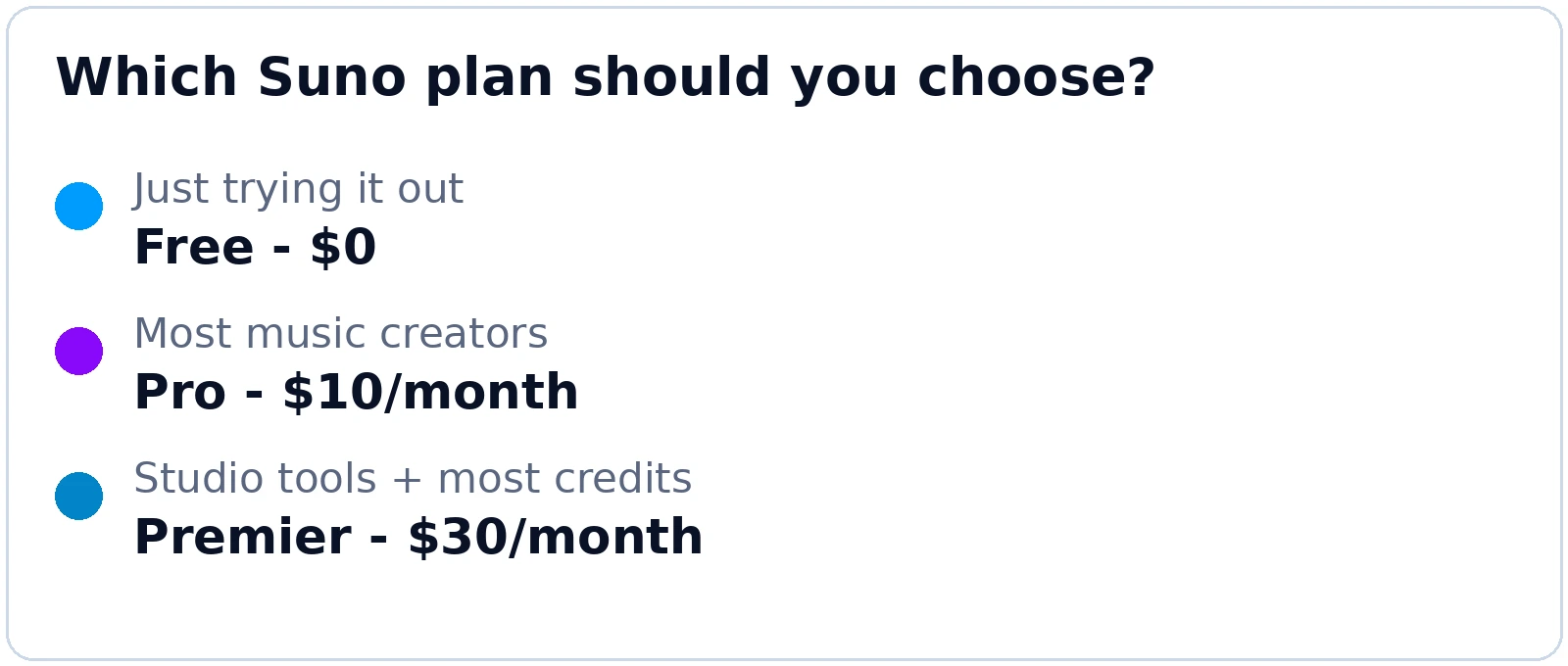
- Stay on Free ($0) if you are exploring or making songs for fun — and accept that Suno owns the output and you cannot monetize it.
- Choose Pro ($10) if you publish or monetize anything you make. This is the right plan for most paying users: commercial rights, about 500 songs a month, 20 downloads, priority queue and stems, at the lowest price Suno sells rights for.
- Choose Premier ($30) if you hit Pro’s download cap, produce at volume, or want Suno Studio’s multitrack editing and MIDI export with uncapped Studio downloads.
- Choose Platinum ($120) if you max out Premier — it is the maximum-volume option: 15,000 song credits and 120 downloads a month, plus 20,000 visual credits for creators who also produce visuals and videos at volume.
- Skip annual billing for now if you are still testing whether AI music earns you anything; take the 20% saving once you know you will be subscribed in month twelve.
Comparing AI subscriptions first? Our Grok pricing guide breaks down xAI’s tiers in the same format.
FAQ
How much does Suno cost per month?
Suno’s paid plans cost $10 a month (Pro) and $30 a month (Premier) when billed monthly. Annual billing lowers them to $8 and $24 a month, charged as $96 and $288 once a year. The free plan costs nothing.
Is Suno free to use?
Yes. The free plan gives you 50 credits a day — about 10 songs — with no payment card and no time limit. The catches are legal, not financial: Suno owns free-plan songs, they are for personal, non-commercial use only, and the plan includes no monthly downloads.
Do Suno credits roll over?
No. Plan credits never carry over: free credits reset every day, and Pro and Premier credits refresh monthly on your subscription anniversary. The only exception is top-up credits bought separately on a paid plan — those never expire, but you can only spend them while a subscription is active.
Can I sell songs I make on Suno?
Yes, if you generated them while subscribed to Pro or Premier — Suno assigns its rights to you, covering streaming distribution and independent sales, and you keep those rights after cancelling. Songs made on the free plan cannot be sold or monetized, and subscribing later does not licence them retroactively. Since September 2026, commercial use also requires downloading the song within your plan’s monthly download allowance.
What happens to my songs if I cancel Suno?
Songs you downloaded while subscribed keep their commercial rights — cancelling does not claw them back. Paid features run until the end of the period you paid for. Top-up credits you bought stay on your account but cannot be spent until you subscribe again.
Prices checked on 2026-11-18 against suno.com/pricing and Suno’s Help Center. Suno changed its download rules in September 2026 and adjusts plans more often than most AI tools; confirm the price and allowances at checkout before you pay.